


Interview With Jacob Meck About the Transfer Station
Now that the Pocahontas County Solid Waste Authority has approved the contract with Jacob and Melinda Meck’s JacMal Properties, LLC, to build the transfer station at the landfill, we interviewed Jacob Meck about the project.
“One of the things I wanted to talk about is why we need a facility -transfer station” said Meck. “(It is) because there’s two waste streams, and one of the things we are seeing in the public comment and in some of these public meetings is (and) I don’t think the public understands that there’s a couple of different sides to this garbage issue, and so it’s easy to say ‘well, we’re just going to take care of green boxes.’ But I want to explain a little bit what the difference is between the two waste streams and what those waste streams are. MSW -or municipal solid waste- is normally bagged household trash. We will see bagged trash from several different sources other than houses. Normally we will see it coming out of restaurants; we’ll see it coming out of hotels; we’ll see it coming out of gas stations. The other side of the waste stream is the C & D -or construction and demolition- and that normally has to do with residential and commercial construction. And so we have to be looking at how we are going to take care of both of these. And I don’t think is fair to the public to say ‘hey, we are just going to take care of one side of it, we are not going to take care of the other side of it,’ because the other side of it is a really big deal.”
“So, let me explain a little bit about the construction and demolition waste,” Meck added. “Let’s say for instance, Mrs. Smith wants a new roof on her house. That cannot go in the green boxes. That is not municipal solid waste, that’s construction and demolition (C&D.) Let’s say we want to put a deck on the back of the house, and we got to tear the old one off -that’s construction and demolition, where is it going to go? Let’s say for incidence we want to to remodel the bathroom -we got a shower, we got a commode, we got insulation, we got 2 by 4s, we got some sheet rock, we got some light fixtures – where are those going to go? That’s construction and demolition waste and that has to be collected with different equipment, and most landfills require that it be separated when it arrives at the landfill. The landfill determines that, but it is not uncommon and even Pocahontas County Landfill down here for years, if we took municipal solid waste or bagged trash in a front load or a rear load packer truck (normal garbage truck) it went one place. When we went in there with construction and demolition, it went in a separate pile -that wasn’t mixed. And so a lot of times those two waste streams are completely handled differently from start to finish. From where that waste was generated to where it was disposed of. That is one reason we need a transfer station is because we have to be able to handle the entire waste stream, both sides of it.”
“Another reason we have to have a facility,” Meck added, “is because of recycling and collection of things like tires, white goods, electronics, cardboard, and there are other things that can be recycled but maybe aren’t recycled currently in Pocahontas County, but maybe at a later date. If we don’t have a facility, we can’t take care of those. And so the Pocahontas County Solid Waste Authority has to have a place of business -and that is what this transfer station is going to be. It is going to be the continued place of business to handle both waste streams , collection of tires, collection of white goods -which include washing machines, freezers, car fenders, light sheet metal, electronics, cardboard, and then hopefully in the near future, there can be some additional things that can be recycled over and above that. But without a facility, without a transfer station, we are done. None of those items can be taken care of.”
“The other thing that I want to mention too,” Meck said, “is that the Solid Waste Authority completely looked at is that if they completely closed that landfill location any longer, could they simply take the green box trash and simply truck it out of here? And I think they did a good job in due diligence, and they determined that the answer is ‘no.’”
“But getting down to those green boxes,” Meck added, “one of the things that’s been contemplated, and even at that public meeting the other day, basically folks are saying ‘hey, lets just take care of the green boxes, we’ll buy some trucks and will haul it out of here.’ The Solid Waste Authority did their due diligence on that, and I was in quite a bit of conversation with them as well. The bottom line is without a transfer station; the green box system will fail. And the reason for that is because garbage is a first of the week/end of the week project. If we had five days to take care of garbage, we’d be OK, but we don’t. So generally what happens is: the general public gets rid of their waste, and they use that green box facility on Saturdays and Sundays. The Solid Waste Authority has Monday and Tuesday to clean up all five sites. Wednesday they are open again to the general public, and then they got another two days to clean it up and they got to get ready for the weekend. So basically, what happens is you get two opportunities- you get a little short window – twice, to clean that facility up and get ready for the next wave of trash. And so what ended up happening is they were looking at it and saying ‘huh, if we don’t have a facility, we limit ourselves to somebody else’s hours.’ And it was not logistically possible to get all five of the green box (sites) cleaned up and have them opened and have them ready for the next available public day in time. And so, I think they did a good job. They looked at it and I can tell you they looked at it and I can tell you that currently -and this is one of the things I’d like to drive home too- is: the Solid Waste Authority is going to continue to run the green boxes and the transfer station. That’s their project, and for them to be able to continue, they have to run both of those items. And the reason they have to run both of those items is because they have to have access to a transfer station 24/7. So basically, to keep the current hours of operation for the green boxes, that Solid Waste Authority, that Solid Waste Authority employee that drives that front-load truck that’s owned by the Solid Waste Authority – he has to work Saturday evening, he has to work Sunday evening. He has to work holidays, and he has to have somewhere for that to go, and so they looked at all the different avenues, they did hour studies, they had Chris run some stuff into Greenbrier County (landfill) and the bottom line is at the end of the day, logistically it just couldn’t be done. Then you throw a 3-day weekend in on top of it, and now we’ve just compounded the issue. And then you throw in C&D. So, the facility is extremely important to collect both waste streams and ultimately keep the green box system opened. If there is no facility to put in, the garbage collapses in this county, it just simply can’t continue. To keep the services the people currently have, there has to be a facility.”
“I’ll tell you another thing that’s happened,” Meck said. “It’s just interesting how things change. Probably about 15 years ago, people started buying dump trailers -small contractors, farmers, even just individual people. A lot of people have a ¾ ton pick-up truck. And these dump trailers-I mean were the greatest inventions since sliced bread- and everybody started buying these things. And what we ended up seeing is folks haul a lot of C&D, a lot of construction and demolition. A lot of these small contractors, that’s how they haul their construction and demolition -in these dump trailers. They’ll just own these as part of their equipment fleet, and they need somewhere to go with it. And so, I think this facility is going to be a big win, even for our small contractors and farmers or individuals. That’s become very, very popular in the last few years. Those things are everywhere.”
“One of the things I wanted to chat about too is this public/private partnership thing just a little bit,” said Meck. “One of the things that happened is Charleston is well aware of what’s going on up here. And Charleston has been at a number of meetings off and on over the last year. And one of the things Charleston recommended last year is -basically our State Solid Waste Board Director came up and in one of these public meetings he said ‘listen, you guys need to team up, and you need to come up with a public/private partnership to solve this problem, because the bottom line is with the amount of garbage Allegheny Disposal is bring in, and the amount of garbage the Solid Waste is hauling off these green box sites, these are the two largest haulers into the current facility, and so, just looking at it as a whole, it’s like one of you guys isn’t gonna be able to solve this, your gonna have to team up on this thing.’ And so, Allegheny Disposal was invited to the table as a partner, recommended by the state. ‘Guys get in a room and beat it out.’ And we have. And there has been a lot of public meetings, and there’s been a lot of conversation, and people could have been at any of those. And I think there has been a couple of things that have happened. -one is that the state looked at this and said ‘OK, Allegheny Disposal is the local garbage hauler, and more than that, not only are we the local garbage hauler, but we have 31 years of construction experience. And so, when you take a look and say what we do here is we do construction and we truck liquid and solid waste. We got 31 years in the construction trade as of right now. That means we have had guys building where I have personally been out on jobs building for 31 years. We’ve been hauling liquid and solid waste for 20 years. On the construction side of it, we’ve got residential, commercial, electrical and plumbing -that’s how we are licensed. And obviously with the liquid and solid waste, we carry a number of DEP permits, we carry a Certificate of Need to haul garbage -which is necessary- so we have all the certifications and all of the licenses to do those two things. And, there is a lot of things, Tim, that I don’t know a lot about, but the bottom line is, one of the things I do know is I know construction and I know liquid and solid waste. Like I say, we’ve been doing construction 32 years, we’ve been doing liquid and solid waste for 20 years. And, on the construction side of things, it’s not just me, this has been a generational thing. And our daughter, she just graduated from WVU with a Civil Engineering Degree, and she is on a construction site today. So, this is what we do.”
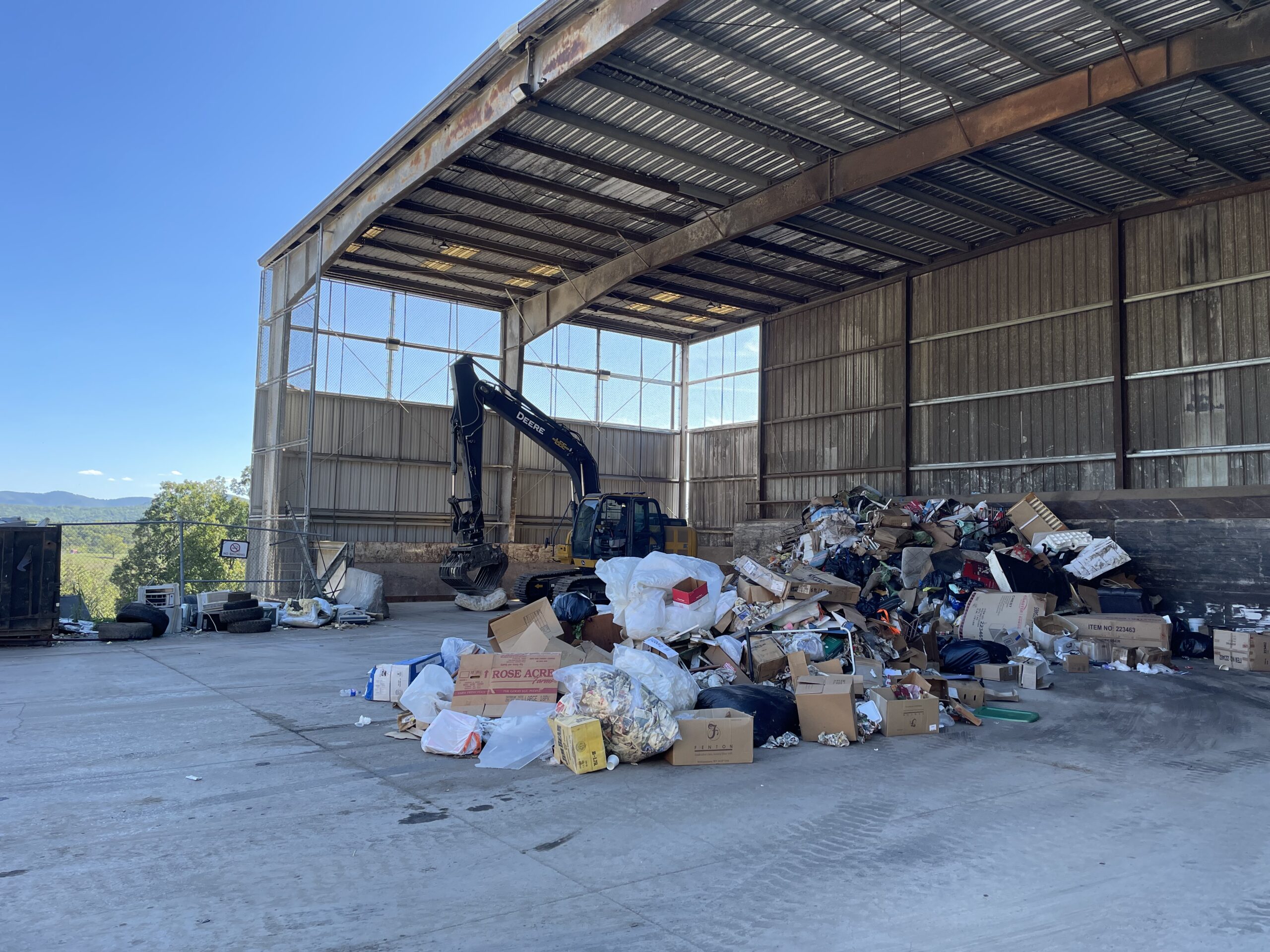
“And another thing,” Meck added, “I’d like to say is the cost of this facility is a big deal to me, it’s a big deal for Allegheny Disposal, it’s a big deal to our community. But one of the things I think is a big win is that we have been figuring out efficiencies for transfer stations for over 10 years. I have visited transfer stations, we have studied transfer stations, we have looked at equipment,” Meck said. “And one of the things that I really like about the design we are putting in down here is -when you drive to Petersburg, West Virginia, and you look at that transfer station for instance, there is ¾ of a million dollars of equipment on that floor to move trash. We’re gonna do that at Pocahontas for half of that, just because we are doing a better job of design. This is a designed build. We are tasked with designing it, building it, financing it, and maintaining it. The Solid Waste is going to run this facility, not Allegheny Disposal. The Solid Waste Authority is going to run the green box facility, not Allegheny Disposal.”
Meck ended by explaining just how professional the construction of this transfer station will be. He said it will include every required permit, high end architectural designs and drawings, and complete compliance with all building codes. He said it will be a facility built to completely meet the disposal needs of the county for 30 to 40 years to come.
If you have feelings about this contract, and would also like to express those, feel free to contact this reporter by email -tim@amrmail.org to request an interview.
To see a short video of a similar design to the new transfer station here, go to the below link:
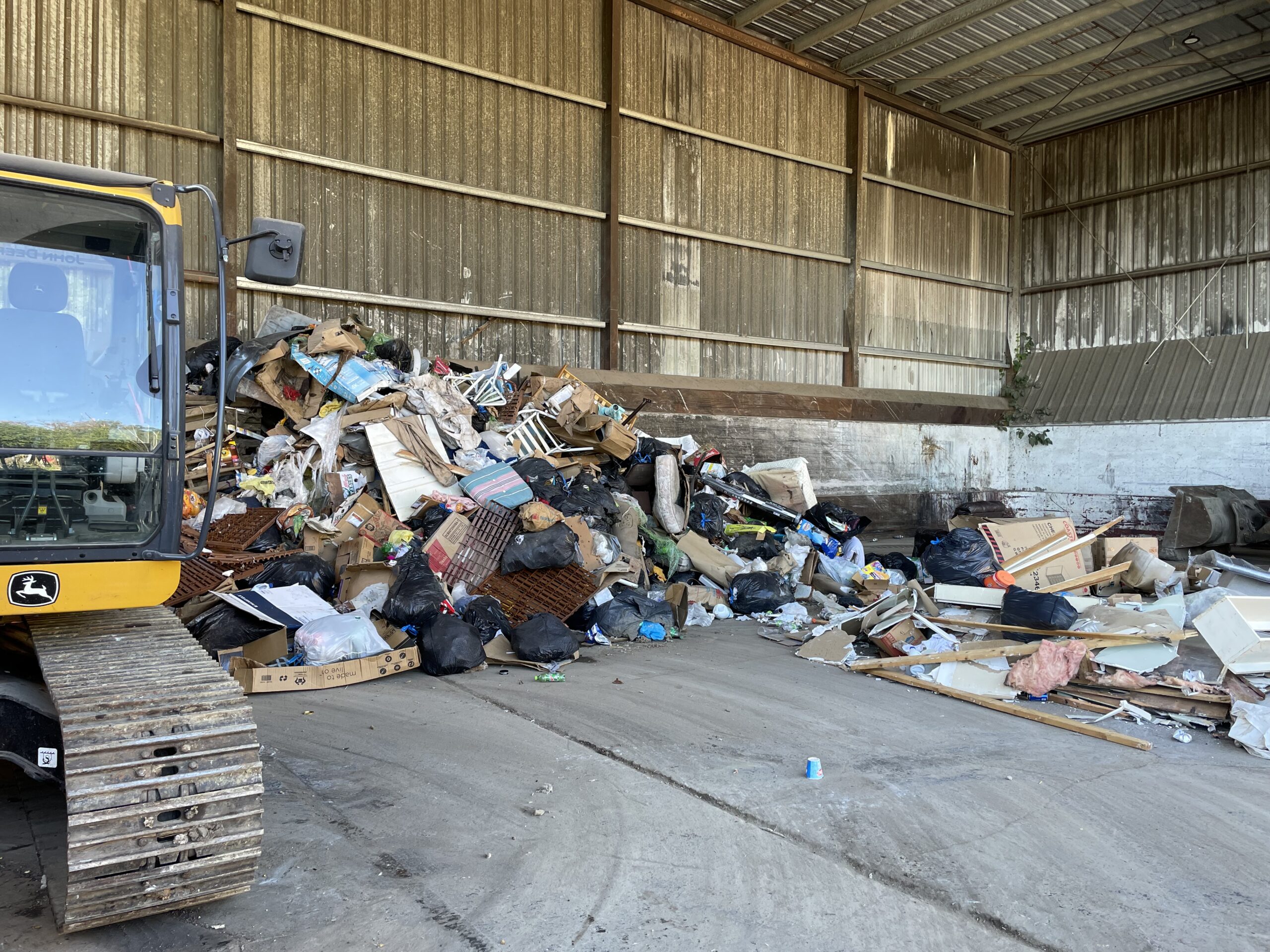
The new Pocahontas Transfer Station will not have loose trash laying about like seen here at the Petersburg, WV Transfer Station
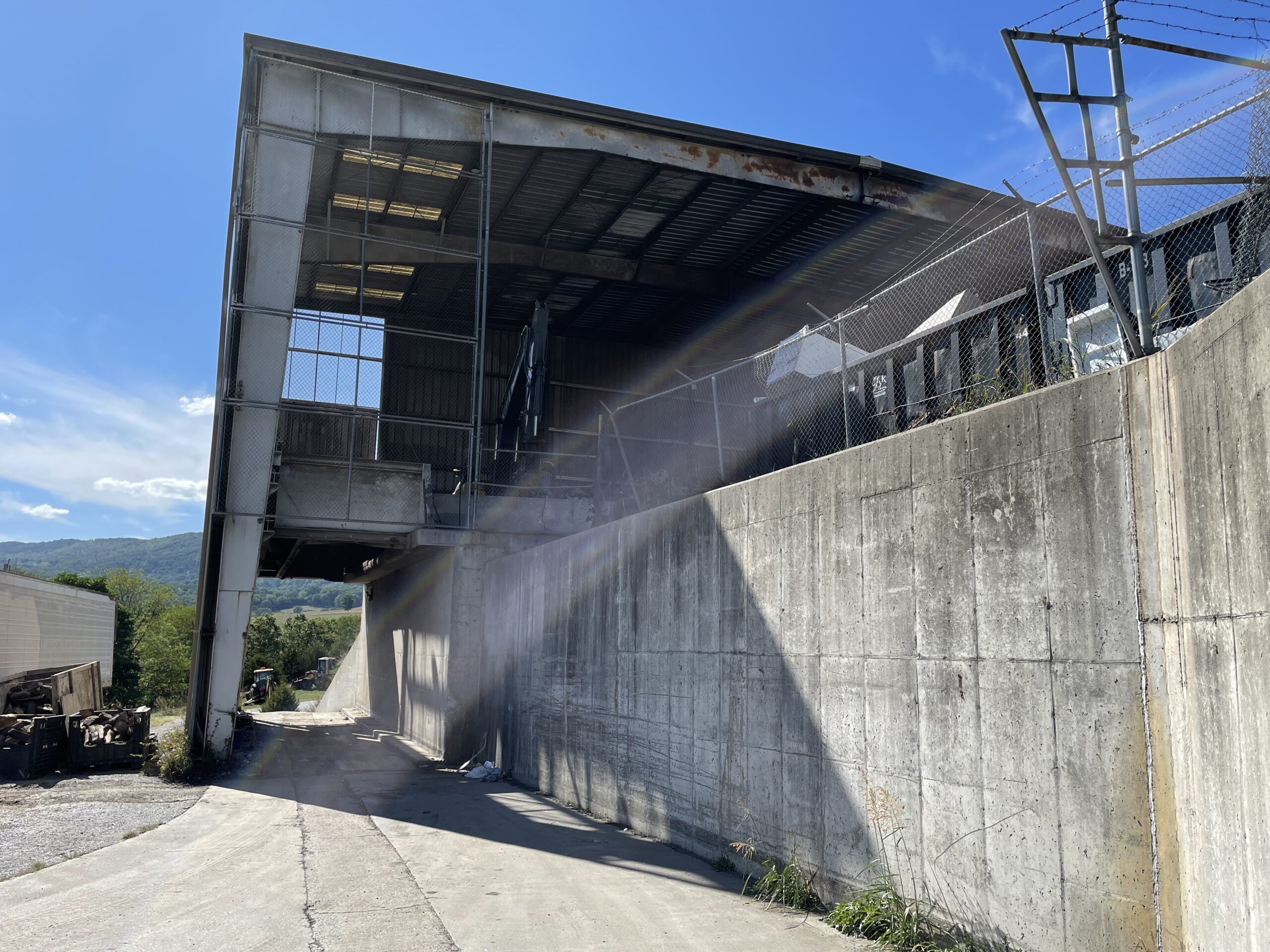
Another view of the Petersburg Transfer station but this view will be similar to the new one here.
Story By
